Paul’s Perambulations

July 19, 2010

WWII COs — My Heroes (and friends) in the fight for true peace.

Filed under: Love, Peace, Religion — admin @ 2:33 pm

I was at the annual PYM Peace Picnic recently and spoke with two WWII veterans (Neil Hartman & Warren Sawyer) – pacifist COs in medical experiments intentionally infected with hepatitis by injection or by drinking fecal water. My friend Russ Tuttle wore lice underwear in typhus tests. These are my heroes…they saved many lives. (more…)

June 25, 2010

I am a co-complainant to the U.N. Human Rights Council

Filed under: General, Peace, Politics, Religion — admin @ 4:25 pm

I am a signatory and co-complainant in a formal complaint to the United Nations. We are waiting to receive a full response. (more…)

March 18, 2010

Was Andrew Carnegie, philanthropist, a “nice” man?

Filed under: Politics, Religion, Work — admin @ 12:24 am

Was Andrew Carnegie, philanthropist, a “nice” man? He had some progressive views, gave away much of his enormous fortune, was very bright and hard working, and died a rich man. The crucial fact is that he was responsible for putting Henry Frick in charge of his Carnegie Steel, and Frick was definitely NOT a “nice” man. But Carnegie knew what he was doing, because now the appalling business practices that profited Carnegie Steel could be attributed to his underling, while he could be seen to soften some of the worst edicts of his Chairman. This approach may favor the financial bottom line, but the ethical bottom line is quite another story. Andrew Carnegie was NOT the “nice” man that he either pretended or imagined himself to be, but a sanctimonious hypocrite of perhaps the worst kind.

October 8, 2009

Pacifist Realism and Pacifism

Filed under: Peace, Religion — admin @ 11:34 pm

Pacifist Realism holds that unless there is radical change in our understanding of, and dependence on, war in our modern technologically-advanced world, there will be wars of ever increasing severity, resulting in our eventual extinction. Pacifism is a conscientious and practical response to this threat. Removing this threat of suffering and extinction does not require that the world become pacifistic, but realistic pacifism can lead the way toward the consideration and adoption of other more accessible methods of establishing peaceful relationships.

Pacifism is the refusal, for reasons of conscience, to participate in war.

April 11, 2009

Some Thoughts on Religious Experience

Filed under: Religion — admin @ 9:34 pm

Fran and I had a three-hour discussion/debate about religion today while reading Dawkins’ The God Delusion and preparing for our Easter family gathering tomorrow afternoon. Two of our topics were 1) a lot of folks will go to Easter services tomorrow (or Passover recently) more from cultural habit than any sincere religious belief. Does this make any sense? Is there any honesty in it? and 2) according to many Christians (including the aforesaid Easter attenders), Quakers are not truly religious but heretical (and so Fran’s relatives hanged them in Boston). I’ll be at Meeting tomorrow morning as usual, but Easter Sunday is not a special event for Quakers.  For Quakers, as a matter of religious faith and practice, each and every day should be celebrated as much as Easter.  Additionally, my type of Quakers speak of the gift of continuing spiritual revelation and not of a bodily resurrection. There’s some interesting biblical support for this view, but I must say that I’ve never met anyone who would change his/her belief in the face of a close reading of the earliest texts. The texts themselves have no significance unless we find them a catalyst for spiritual growth. FOR A SUBSTANTIAL TREATISE ON MY RELIGIOUS THINKING, SEE COMMENT #2.

March 18, 2009

Is It Appropriate for a Christian Institution to Support a Military Unit on Its Campus?

Filed under: Peace, Religion — admin @ 4:01 pm

Is It Appropriate for a Christian Institution to Support a Military Unit on Its Campus?

Presented by Paul Sheldon & Joseph Betz, on Wednesday, March 18, 2009, 12:30-1:20 p.m., in Room 300, SAC.

The life of Jesus brings a new covenant between God and man. The Prince of Peace tells us to put away the sword, trust in the Armor of God, and to love our enemies. If we are to give to Caesar what is Caesar’s and to God what is God’s, which do we put first when these two appear to conflict? Until the time of Constantine, Christianity functioned apart from the Roman government, and complicity was minimal. How has the Christian message of love and forgiveness changed in the intervening centuries? What are the responsibilities of the academic Christian community in this regard? If you have questions, please contact paul.sheldon@villanova.edu.

***

The announcement above was distributed to all Villanova faculty and staff via the Campus Currents page, and in addition was separately sent to various departments (including Naval Science) and individuals who might likely have a special interest in the topic (background material leading up to this event is at the bottom of this post).

About twenty-five of us were present. At the start of the discussion I distributed the following list of queries that I felt might help inspire discussion:

Would Jesus understand why Villanova has an ROTC on campus?

What does the bible tell us about Jesus’ views on war and peace?

If we say that Jesus would sometimes condone war, then when, why, and how?

Have recent wars met the standards of Christian just war?

What choices do ROTC students have for ethical decision making according to Christian just war standards?

Can we be assured that ROTC students will be called to use their military skills only in wars that meet Christian just war standards?

We are evaluating ROTC programs, not the participants.

Should an academic institution have programs over which it has no control?

What is the purpose of military training?

I am grateful for the quality and variety of the discussion, and that we were not distracted by any knee-jerk animosities. I will not try to reproduce the hour here.  I have copied three items that I think are relevant to the discussion into Comments below.

I had prepared myself for debate on specific biblical texts as well as the work of Augustine and Aquinas on just war theory. Fortunately, considering our limited time, we did not delve heavily into such details. It seemed sufficient to note that the few texts of Jesus that talk about support for government are notably ambiguous, while the many statements of love and forgiveness are clearly stated.  (Incidentally, my father’s Ph.D. was in biblical text criticism.)

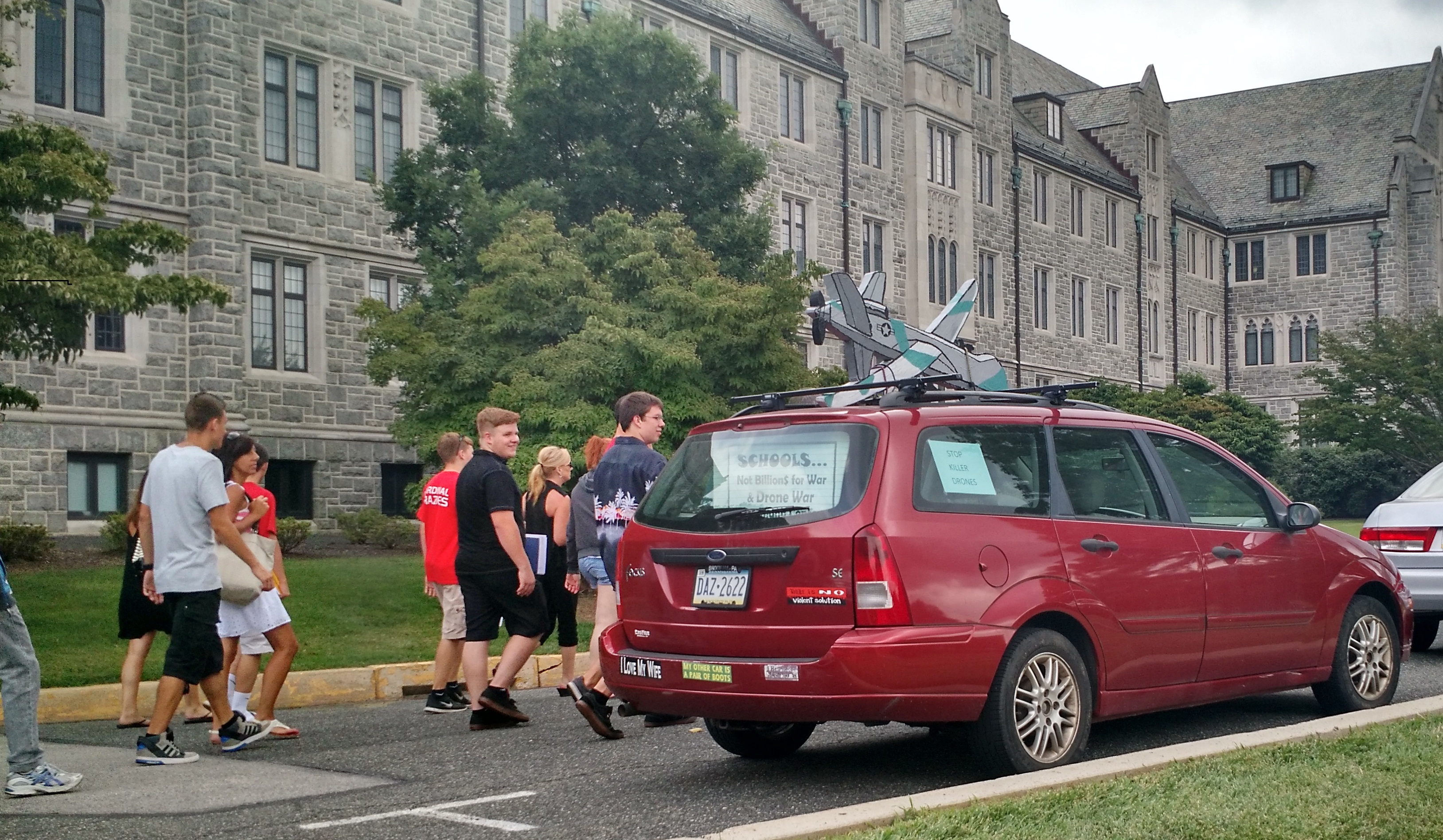
Some background: This Ethics discussion was a key opportunity to discuss the question that I have posed on campus via the large sign in my office window that asked “Who Would Jesus Train to Kill?” (see www.peacefulways.com/  and http://blog.peacefulways.com/ and Search for Jesus for more) The physical presence of this sign generated considerable attention and comment.  But disappointingly, no one ever dealt with the question itself. When I moved to a smaller adjunct office this year, I did not want to let this question disappear without being addressed at Villanova. Thus I arranged (with the help of Joe Betz in the Philosophy Department) for an Ethics for Lunch discussion on this topic. I hosted a similar meeting two years ago on the topic of “Is conscientious refusal to pay federal taxes for war an instance of civil disobedience based on holy obedience to God’s will for peace?”

January 29, 2009

Journey of a Quaker Marriage (Published in Friends Journal June 2009)

Filed under: Love, Religion — admin @ 10:37 pm

A Quaker wedding may appear to be a relatively simple affair. During a Meeting for Worship for Marriage, a couple publicly declares their love and continuing commitment to one another. Nothing more is required. However, what Quakers reject in formalisms and ceremonial trappings, they more than compensate for in preparation, and that is especially true for significant life events such as marriage. A couple who wishes to be married under the care of a meeting is required to seek spiritual guidance concerning how they understand their current relationship, what they want it to become, and how they can best help it develop. When they feel they have achieved this understanding, a Clearness Committee tests their leading for marriage. This is no simple task but an extraordinary undertaking, valuable for its practical contribution to a successful marriage as well as for the spiritual enrichment of the couple as a family unit and as individuals.

My wife and I had many lively discussions in the course of writing our vows and discussing what they meant in the context of our intended marriage. We agreed that a basic requirement was that our marriage be an open and honest relationship between equals. Without a base of equal power and commitment, any attempt at this is fatally compromised. This sense of an open marriage should not be confused with the so-called “open” marriages of the 70’s that skirted marital responsibilities in the name of freedom.

We asked ourselves whether anyone could honestly promise to love a partner forever. We acknowledged that love can never be totally secure. Marriage does not change that fact. The heart follows its own course, and we would not pretend to promise the heart. We considered that perhaps it is preferable to make an ideal promise and fall short, because the promise provides a clear goal. Ultimately we realized that change is inevitable and can be seen as an opportunity for love to grow, not as something to be feared.

We acknowledged that the root of Quaker marriage is spiritual responsibility. The root of love is continuing revelation. You must accept spiritual responsibility in marriage for the continuing revelation of love. Although love is spontaneous, with mutual seeking a couple can construct the contexts that favor love’s growth and development. At the same time, we recognized that even the best-intended spiritual seeking is not necessarily rightly led.  If either of us ever felt the need, we would call upon our Clearness Committee to help us test the source of significant leadings. Such testings can generate valuable insights to help guide a successful marriage.

A loving relationship represents commitment to the partner, not ownership. Because we are still growing as individuals, what we should wish for our spouses is no less than we would wish for our children. As I said to Fran at our wedding, “My love is intended not to encumber your freedom, but to support you along your life path, so that you may live fully and authentically.”

I experience my love for Fran as unconditional love. I find this to be a life-changing feeling. It does not mean that I never get angry.  Fran and I are blessed to be amazingly well matched, but we are not perfect.  I do believe that perfect love, in the sense of being forgiving, understanding, and having total confidence in one’s love, is achievable. Such love blesses both the giver and the receiver, and even the world beyond.

I have long been an antiwar activist, our marriage is a source of inspiration and empowerment for my work in this area. My love for my wife leads me to understand that war is totally wrong because it destroys the lives of people who also love and are loved. This is an example of how the continuing revelation within marriage becomes part of the evidence of God’s love for all humankind, and how the marriage partners become a channel for expressing this love in the world.

Fran and Paul have shared their lives for seven years, and they publicly declared their marriage at Lansdowne Friends Meeting (PA) in October 2005.

January 28, 2009

Thoughts, Ideas, and Principles

Filed under: Love, Peace, Politics, Religion — admin @ 9:16 pm

In response to a query on my Facebook page, I posted twenty-five “Thoughts, ideas, and principles” recently. Since this material might not be readily accesible by some, I have added it as a comment below for those who don’t have Facebook accounts.

September 23, 2008

“Who Would Jesus Train To Kill” Window Sign

Filed under: Peace, Religion — admin @ 11:40 pm

In response to a visit this evening concerning a sign in my window (see title above), I wrote the following email to my Department Chairperson. OSA refers to Order of Saint Augustine. There is more information and a picture at my website www.peacefulways.com/ (click on Conscience and Militarism).

Hello Tom,

It was good to speak with you a few minutes ago in reference to my being visited a few minutes earlier by Corporal Hall of Villanova Security, his presence at my door being at the request of certain members of the OSA complaining about my sign.  It was good to confirm that you have spoken previously with Fr. Peter concerning my sign, as have I, and to confirm that his response was not of a critical nature.  In fact, my sign has generated some meaningful interaction with a number of members of religious orders on campus, including members of the OSA.  No one has ever questioned the appropriateness of my placing it in my window.  I believe it poses a relevant question for each to answer in his/her own heart — it does not propose any specific answer. My website www.peacefulways.com/  provides further information.

What is my response to learning that some members of OSA appear to be unhappy with this sign?

1.  I believe most strongly both that this sign is appropriate for a Christian institution, and that I have a right (indeed, an obligation) in my academic position to pose such a question.

2.  I intend to keep this sign (or a copy) in my office window while I am a tenured faculty member.  It is not my intention to be confrontational.  The fact that some may disagree with the sign, or even may find it upsetting, does not lessen its value as a catalyst for significant discussion.  It is my sense that this is what an academic institution is all about.

Peace,

Paul

June 20, 2008

Book Review on Quakers published in Journal for Peace & Justice Studies

Filed under: Religion — admin @ 10:16 am

Readers who would like some background information about Quakers might find helpful my review of Yount’s How the Quakers Invented America (published this month in the Journal for Peace & Justice Studies, v17, #1).  I  have copied it into Comments.

Older Posts »

Powered by WordPress